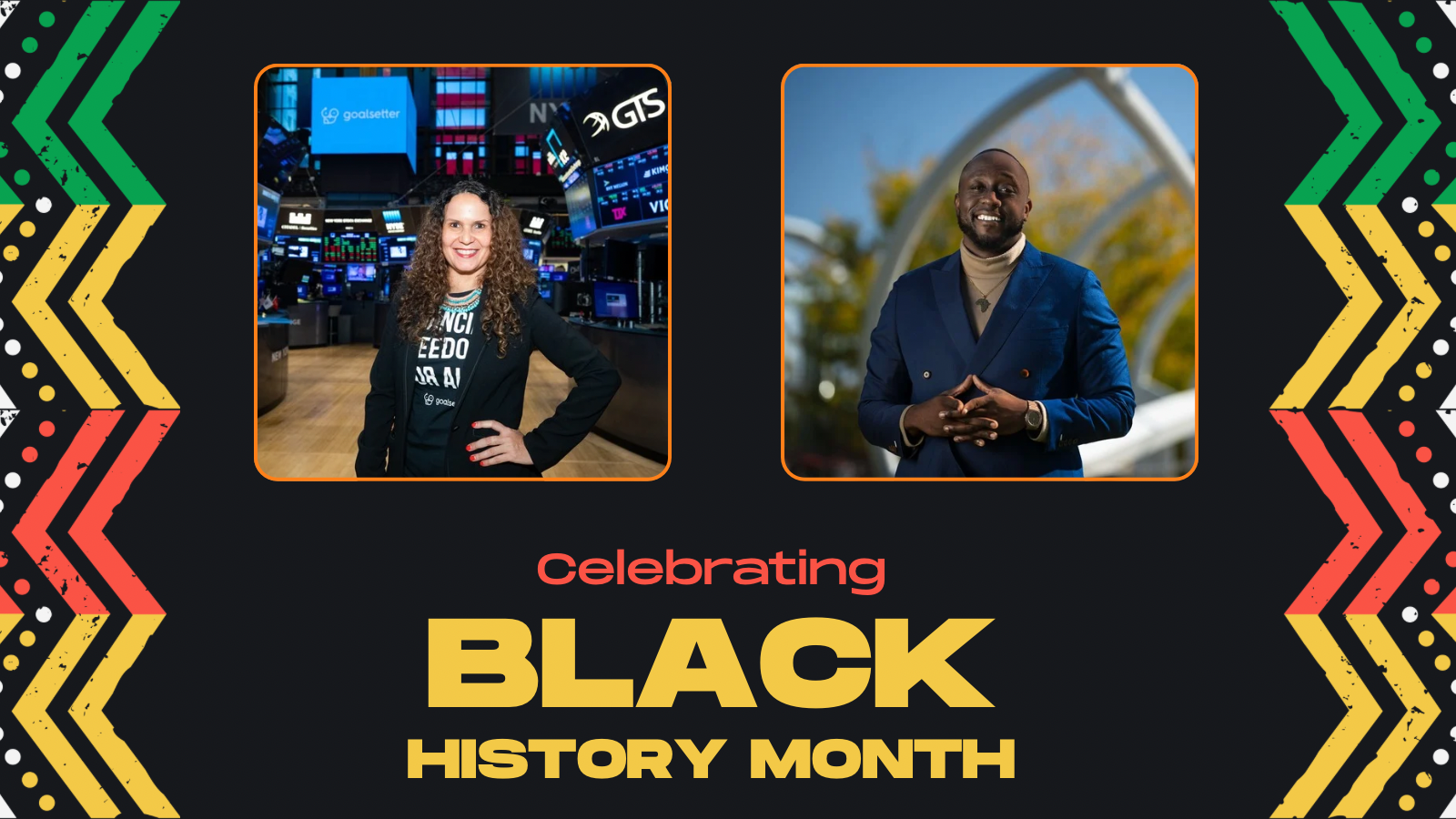
Celebrating the accomplishments of Black entrepreneurs during Black History Month highlights the powerful role that vision, resilience, and community support play in driving meaningful change.
In that spirit, we’re highlighting two remarkable Black founders from the Elevate Capital portfolio, Tanya Van Court, founder and CEO of Goalsetter, and Obi Omile, co-founder and CEO of theCut, as they share their unique challenges, invaluable advice, and guiding principles as entrepreneurs. These visionary leaders are building generational wealth and making meaningful and lasting impacts nationwide.
Tanya Van Court’s Mission to Close the Wealth Gap Through Financial Literacy

Tanya Van Court is the founder and CEO of Goalsetter, an award-winning platform that equips families with financial literacy tools. Recognizing a gap in financial education, Tanya created Goalsetter to provide an engaging, fun way for children and families to learn about money management.
Goalsetter offers a variety of features, including savings accounts, financial literacy quizzes, and a unique “Learn Before You Burn” app that encourages kids to learn before spending their allowance. Tanya’s passion for financial education is inspiring a new wave of financially savvy youth, helping to close the wealth gap and foster economic empowerment.
What unique challenges did you face as an entrepreneur, and what advice would you share with others navigating similar paths?
One of the biggest challenges was navigating a system that wasn’t built for me. Access to capital, mentorship, and insider networks often felt like closed doors. I had to create my own playbook and relied heavily on personal grit, a strong belief in my mission, and the willingness to show up in rooms where I might have been the only person who looked like me.
I would say, don’t wait for validation. Lead with data, lead with results, and let your impact speak volumes. Leverage every part of your story, not just where you come from, but what you know and what you’ve achieved. And most importantly, find a community of peers and allies who understand the journey and can provide support, insight, and honest feedback.
What’s the best piece of advice you’ve ever received as a founder?
The best advice I’ve received is simple but powerful: Don’t chase money. Chase impact, and the money will follow.
When I stopped focusing on proving myself to investors and started focusing fully on the lives I wanted to change, everything shifted. People invest in authentic vision and measurable outcomes. If your purpose is real, and your execution is strong, capital and support tend to follow.
If you could leave future entrepreneurs with one guiding principle, what would it be?
Build with courage, not comparison. The moment you start measuring your journey against someone else’s, you dilute your own voice and vision. Your superpower, especially as a founder, lies in your unique lived experience and how it informs the problems you choose to solve. Honor that. The world doesn’t need more of the same; it needs more of the bold, different, and deeply personal.
>> Follow Tanya Van Court on LinkedIn
Obi Omile Redefines Men’s Barbershop Culture and Connections

Obi Omile is the co-founder and CEO of theCut, a mobile platform revolutionizing the men’s grooming industry. With over 10 million users nationwide, theCut connects barbers and clients to streamline appointments and elevate the barbering experience.
The company equips barbers with tools to manage their businesses, from scheduling to payments. For clients, theCut simplifies finding and booking trusted barbers in their area. Obi Omile’s vision is reshaping the grooming industry and setting new standards for service and professionalism.
What unique challenges did you face as an entrepreneur, and what advice would you share with others navigating similar paths?
In our early days, we faced a range of challenges—some specific to being underrepresented founders and others simply part of entrepreneurship. These included investors struggling to understand the need for our offering and limited access to warm introductions within investor communities. As founders, it’s our responsibility to navigate around these obstacles.
Ultimately, these hurdles made us more resilient as a company. We had to work twice as hard to break into those circles, and once we were inside, we had to work even harder to hone our storytelling. These are two skills every entrepreneur must master.
It’s never an investor’s job to understand your business—it’s your job as a founder to paint the narrative so they can see the bigger picture. You have to get exceptionally good at telling your story. Once you bridge that gap, you’re not just convincing investors, but also early employees and customers.
As a founder, creativity in problem-solving is essential. We tapped into our university alumni investor networks to raise early capital. Once that door was open, it was on us to close the deal by telling a compelling story.
What’s the best piece of advice you’ve ever received as a founder?
The first is that it’s always better to be a painkiller than a vitamin. Vitamins are nice to have, but painkillers are a necessity. When building your product or service, you want to be a painkiller—something your customers crave and can’t live without. When someone needs a painkiller, they actively seek it out. That’s the energy you want from your customers. It makes growth easier and significantly increases stickiness.
The second is that distribution matters above all else. People build amazing products all the time, but the biggest differentiator among the most successful companies is their ability to reach customers. The better you understand your end consumer, the easier it becomes to predict where and how to reach them. If you can build distribution directly into the product, you accelerate your flywheel. Leveraging early customers to drive referrals is often the fastest path to virality and rapid growth.
Lastly, the part of your business you avoid the most is usually the part you need to focus on. As founders, we have to be brutally honest with ourselves. Ignoring what isn’t working is the fastest route to failure. Facing those issues head-on is essential to building a lasting business, especially when it comes to hiring.
Be slow to hire and fast to fire. If the writing is on the wall, you need to act quickly. It’s painful, especially when relationships are involved, but another related piece of advice we’ve followed is to give employees strong exit packages. While neither side is happy about the outcome, it softens the blow and allows everyone to move forward.
If you could leave future entrepreneurs with one guiding principle, what would it be?
Having the right people on your team is worth more than you think. Paying up for top talent early has a compounding effect. Highly qualified individuals tend to work harder and more efficiently than those hired primarily for a lower cost, ultimately saving you money in the long run.
>>Follow Obi Omile on LinkedIn
Building a Future of Inclusive Innovation
The experiences of Tanya Van Court and Obi Omile exemplify how breaking barriers and staying dedicated to one’s mission can create a ripple effect of opportunity and inspiration for Black founders.
By supporting and amplifying diverse voices, we lay the groundwork for a more inclusive future—one where innovation thrives, and opportunities are accessible to all.